Google Just Made Your Cheap Conversions More Expensive
4 min read
Google now pushes budget-capped campaigns up toward your target CPA. Same spend, fewer conversions. Here's what changed on August 17.
Simul Sarker
Founder & Product Designer of DataCops
Last Updated
August 18, 2026
Starting August 17, Google stopped letting budget-capped campaigns spend below their target CPA. If your campaign was beating its target, it's about to stop.
Google made a change on August 17, 2026. It sounds boring. It is not boring.
Here is the short version. If your campaign has a daily budget, and that budget was stopping you from spending up to your target CPA, Google used to just let you keep the savings. Now it won't. Google will push your cost per conversion up toward your target, on purpose, using the same budget.
What actually happens to the number you see
Say your target CPA is $10. Your budget was small, so you were actually paying $5 per conversion. That was a good result. You were beating your own goal.
Starting now, Google nudges that $5 up toward $10. Your budget stays the same. Your spend stays the same. But now each conversion costs more, so you get fewer of them.
Google says it will not touch your target or your budget automatically. That's true. But it doesn't need to touch either one. It just needs to stop protecting you from your own target when your budget was doing that job for you.
Why Google is doing this
Think about why a target CPA exists in the first place. It's supposed to be a goal, not a floor. You tell Google "I don't want to pay more than $10 per conversion," and Google tries to stay under that.
For years, if your budget kept you well under your target, that was a bonus. Free efficiency. Google is now treating that efficiency as a problem to fix instead of a result to protect.
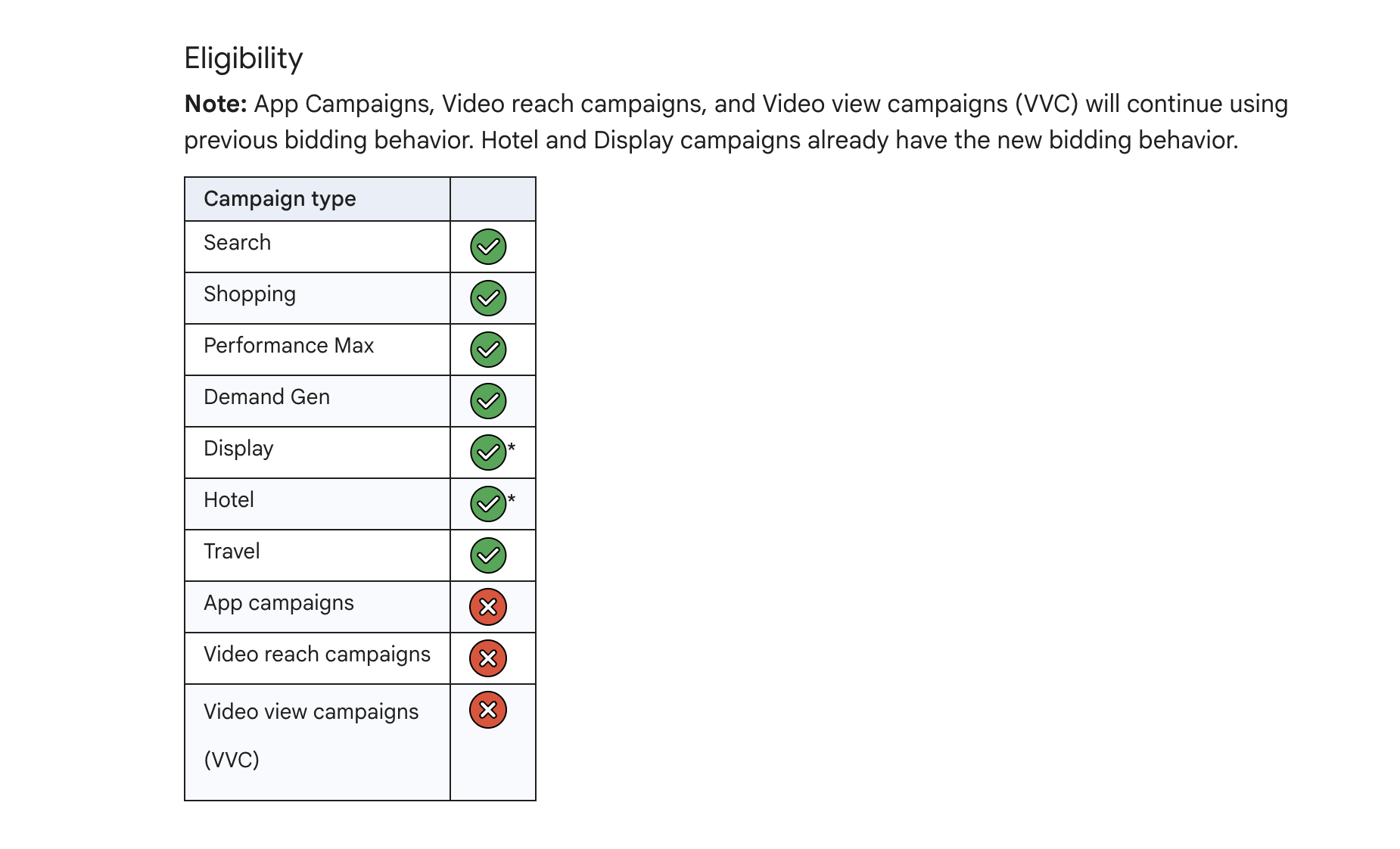
This applies to Search, Shopping, Performance Max, Demand Gen, and Travel campaigns. It also applies to Target ROAS the same way, just backwards. If your return was better than your target, Google will let it drift down toward the target instead of keeping it high.
Why this is bigger than one Google update
This is the same story every ad platform is quietly telling right now. A number that used to help you is being redefined to help the platform instead.
The target you set was supposed to be a ceiling. Google just turned it into a floor. Nobody announced this loudly. Most advertisers won't notice until their reports look worse in a few weeks, and they won't know why.
If you're planning Q4 budgets right now, this change will already be baked into your numbers by the time you're reading your October report. And here's the part that makes it hard to catch: Google is also removing campaign-level language targeting and rolling out AI Max conversion in the same September window. Three changes hitting the same accounts, all in one stretch. Good luck telling them apart in your reports.
What you should do about it
Check your target CPA and target ROAS campaigns this week. If any of them were beating their targets by a wide margin, expect that gap to close over the next 30 to 60 days.
Don't panic and lower your targets right away. Give it one full conversion cycle first. Watch the actual cost per conversion, not just the total spend, because total spend is the number that will look fine while everything else quietly gets worse.
And remember: the number Google shows you is only as good as the definition sitting behind it. That definition just changed, and Google didn't send a memo.
Source: Google Ads Help — Changes to target based bid strategies
DataCops is a no-code server-side tag manager. It validates each conversion at the source and filters out bot traffic before it reaches Meta, Google, LinkedIn, TikTok and more.



