DataCops vs TrafficGuard
TrafficGuard charges roughly 2 percent of your ad spend. Forever. For web advertisers, that is a tax on growth.
TrafficGuard is a genuinely strong tool. In mobile app install fraud, working with mobile measurement partners, catching install fraud and SDK spoofing, it is one of the best on the market. Web fraud is the secondary act. If you came to TrafficGuard as a web advertiser running Google Ads and Meta, you bought a mobile-fraud specialist and are using its side feature. DataCops is the web-first answer because it does web fraud, CAPI hygiene, and analytics in one first-party stack.
Start FreeBlocking bots is table stakes. What happens after is what matters.
DataCops detects, blocks, and feeds clean signals back to your ad platforms - in one layer, not three separate tools.

One platform that captures, verifies, and activates - instead of patching three tools together.
Click fraud filtering is half the web problem.
Blocking a fraudulent click protects that click's budget. It does nothing about what the fraud already did to your data. Of the traffic that does get collected in a typical funnel, 24 to 31 percent is bots. A click-fraud tool exists to stop the click. It does not clean the conversion data, and the conversion data is what your ad platforms learn from.
What the gap actually looks like
The 2 percent math: at $5,000/mo ad spend TrafficGuard is $100, even with a flat-fee tool, break-even. At $20,000/mo TrafficGuard is $400 while a flat-fee tool is still $100, you are paying 4x. At $100,000/mo TrafficGuard is $2,000. At $500,000/mo TrafficGuard is $10,000 a month, $120,000 a year, for click fraud filtering. The crossover sits low, around $5,000 to $10,000 a month in spend.
Your fraud signal does not reach your CAPI. You block a fraudulent click in your fraud tool. Good. But that user may have already been counted as a conversion event sent to Meta or Google server-side. Meta and Google train their delivery on the conversions you feed them. Feed them bot conversions and they learn to find more bots. A standalone click-fraud tool sits in its own silo. It does not scrub your CAPI feed. The fraud you blocked still poisoned the algorithm.
You are running three tools where one would do. Click fraud in TrafficGuard. Analytics somewhere else. CAPI somewhere else again. Three bills, three dashboards, three integrations, and none of them talk. The fraud signal never informs the analytics, the analytics never inform the CAPI hygiene.
How DataCops fixes TrafficGuard's gap
DataCops is not a mobile install-fraud specialist and will not pretend to be. If you are mobile-first and live in MMP integrations, TrafficGuard is the better fit and you should stay. For a web-first advertiser, DataCops is built on a different shape. First-party architecture running on your own subdomain, which means web fraud filtering, analytics, and CAPI all live in one pipeline instead of three silos.
Web fraud filtering happens at ingestion, against a 361.8 billion-plus IP database that separates residential from datacenter, VPN, proxy, and Tor. That is the same place your analytics and your CAPI feed get processed, so the fraud signal actually reaches them. Bots get filtered before the conversion data trains Meta and Google. CAPI to Meta, Google, TikTok, and LinkedIn comes from the same stack. One pipeline, one bill.
Honest limitations: DataCops is a newer brand than TrafficGuard, which has years and a known name in mobile fraud. SOC 2 Type II is in progress, not finished, so a regulated buyer who needs that certificate today should weigh it. The shared-CAPI capability is in verification. DataCops surfaces fraud context, it gives you the IP intelligence and the signal, rather than positioning itself as an absolute fraud blocker.
Cut fraud spend in one afternoon
Point your tracking at DataCops and bot traffic stops draining budget within minutes.

Add the Tracking Script and Validate
Paste this into your website's <head> tag:
<script src="https://datacops.yourdomain.com/core.js"></script>Point Your DNS to DataCops
Add one CNAME record:
Live in 5-30 minutes. Complete data capture begins automatically.
Integration
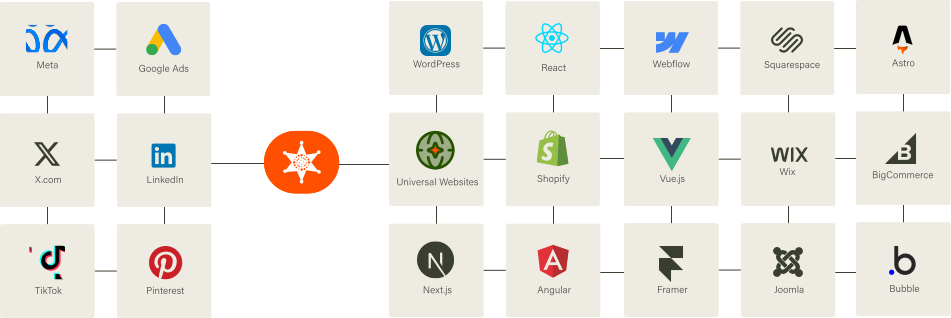
Our Script almost works flawlessly with any website framework to collect analytics data in a more accurate manner!
FAQ
Most fraud tools rely on IP blacklists and basic heuristics - effective against older bots, weak against modern ones that rotate IPs and mimic human behavior. DataCops uses device fingerprinting, interaction patterns (mouse, scroll, keystroke timing), and network signals (proxy, VPN, datacenter) scored in under 50 ms, then blocks or flags before conversion tracking fires.



