DataCops vs IPQualityScore
IPQS is a scoring service. The transaction ends there. DataCops is built first-party so the verdict ships downstream into Meta and Google CAPI in the same pipeline that produced it.
IPQS flagged the fraud fine. That was never the problem. The problem showed up three days later, when I pulled the Meta Ads report and saw that every signup IPQS had told me was a bot had still been counted as a conversion by Meta's pixel. So I had a perfect fraud score and a poisoned ad account at the same time. The honest comparison between IPQualityScore and DataCops is not about scoring. It is about whether the score ever leaves the API response and reaches the systems making spend decisions.
Start FreeSignup fraud for marketers, not just checkout teams
Generic fraud platforms are tuned for payment risk. DataCops is tuned for the patterns that show up in paid acquisition funnels - fake leads, bot signups, and incentive abuse.

One platform that captures, verifies, and activates - instead of patching three tools together.
The verdict dies inside the API response.
IPQualityScore is a scoring service. You send it an identifier, it sends back a risk verdict. The transaction ends there. In almost every stack audited, what happens next is: nothing reaches the ad platforms. Your fraud tool and your ad-measurement tool never speak.
What the gap actually looks like
Someone clicks your Meta ad. The Meta pixel fires the moment the page loads. They land on your signup form, submit it, and your backend calls IPQS. IPQS says fraud, score 91, datacenter IP. You block the account. Good. But the pixel already fired. Meta already logged a landing-page view and a conversion. IPQS never knew the pixel existed.
The bot-contaminated, human-distorted signal you feed Meta and Google is training data. Their optimization engine learns from it. Feed it bot conversions and it gets better at finding bots. ROAS degrades. It looks like a creative problem or an audience problem, so you test more creative. The real cause is upstream. Garbage in, garbage optimized, garbage out.
A B2C client ran a honeypot to size this. About 3,000 signups came through. 77 percent were fraudulent. 650 of those accounts traced back to a single device fingerprint. One machine, hundreds of users. Their fraud API had scored most of them correctly. And their Meta pixel had counted nearly all 3,000 as conversions, because the verdict and the pixel were never wired together. Meta spent the next two weeks optimizing toward whoever was running that machine.
How DataCops fixes IPQS's gap
DataCops is a first-party data pipeline with fraud intelligence built into it. It runs on your own subdomain. Signup verification, bot filtering, analytics, and CAPI delivery to Meta, Google, TikTok, and LinkedIn all live in the same pipeline. The fraud verdict is produced and delivered in the same system, so a flagged signup does not get sent to Meta and Google as a good conversion.
Bot filtering happens at ingestion, before the data leaves your infrastructure, against an IP database of 361.8 billion-plus addresses covering residential, datacenter, VPN, proxy, and Tor. Because it is first-party and runs on your own subdomain, it is far more resilient to the ad blockers and tracking blockers that drop a chunk of third-party scripts. The free tier gives you 2,000 signup verifications a month.
DataCops is a newer brand than IPQS, and IPQS has years more name recognition. SOC 2 Type II is in progress, not finished, so a regulated buyer with a hard compliance gate may need to wait. The shared CAPI delivery to multiple platforms is in verification, not fully live across every channel yet. DataCops surfaces fraud context for your decisions, it does not promise to block 100 percent of fraud or detect every bot.
Stop paying for fake leads
Paste the tracking snippet, map your form, and fake signups drop to zero within the hour.

Add the Tracking Script and Validate
Paste this into your website's <head> tag:
<script src="https://datacops.yourdomain.com/core.js"></script>Point Your DNS to DataCops
Add one CNAME record:
Live in 5-30 minutes. Complete data capture begins automatically.
Integration
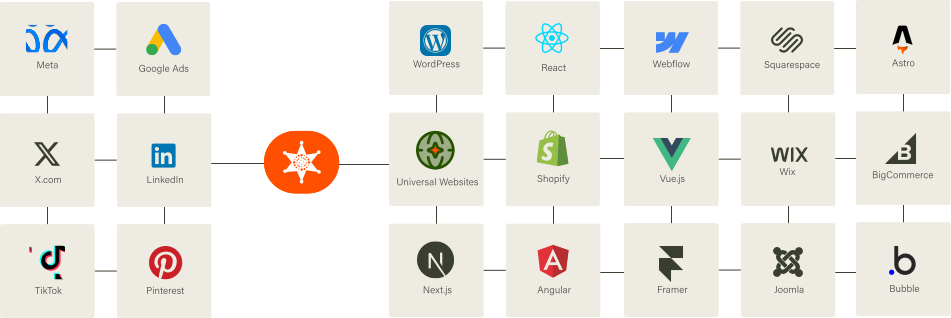
Our Script almost works flawlessly with any website framework to collect analytics data in a more accurate manner!
FAQ
Tools like Castle, Sift, and SEON were built for checkout and account-takeover fraud. DataCops is tuned for the marketing funnel: disposable email domains, rapid account creation, VPN abuse, and fake lead forms driven by ad campaigns. Risk models are trained on signup-specific patterns, not card-not-present fraud.



